How New Horizon Counseling Center Strengthened the Performance of Its Health Home Program
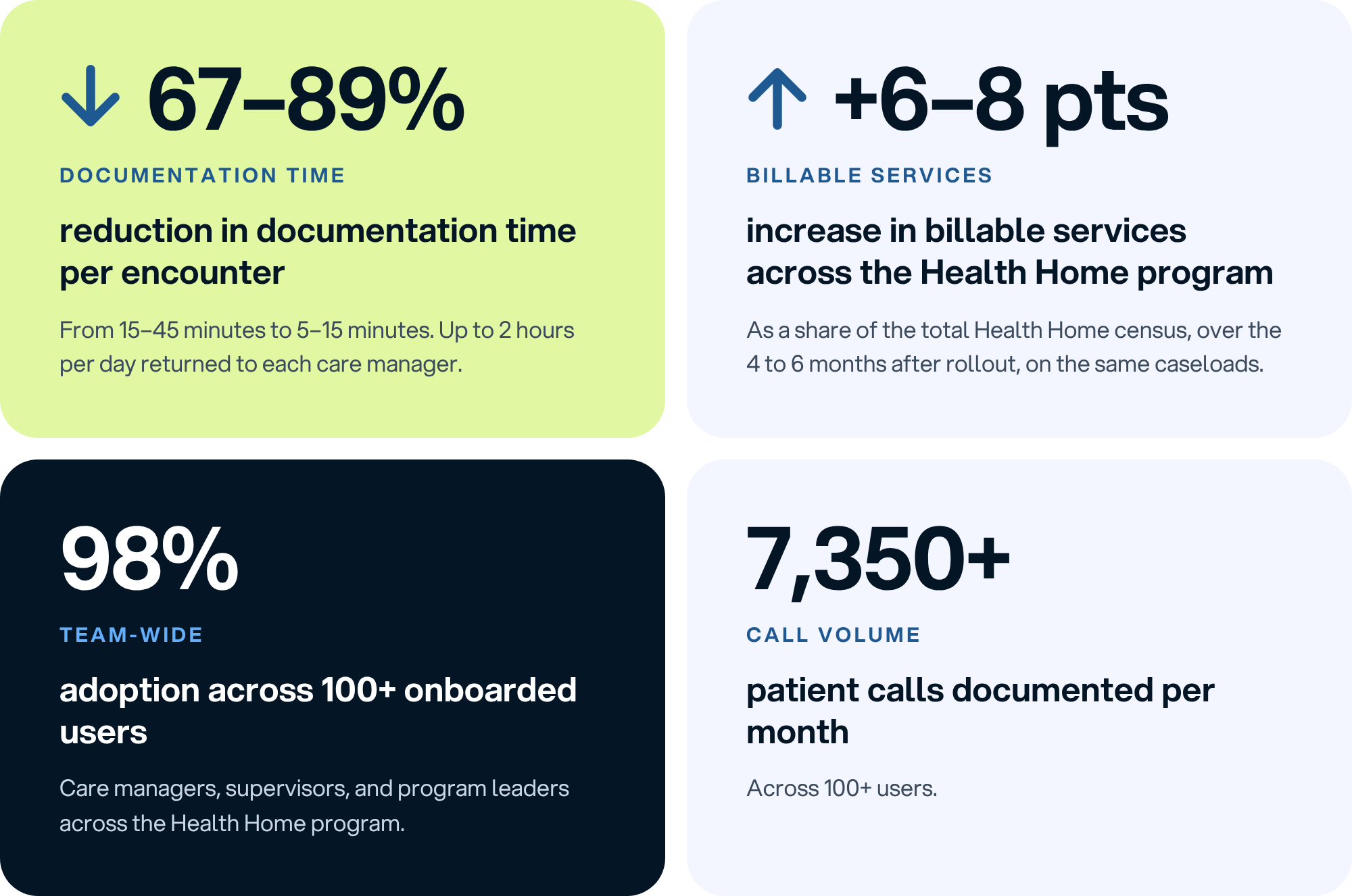
NHCC cut documentation time by 67% to 89% and raised billable services 6–8 percentage points


At-a-Glance
New Horizon Counseling Center (NHCC) is a behavioral health organization with more than 40 years of history in New York City, spanning outpatient mental health clinics, developmental disability services, Assertive Community Treatment (ACT) teams, and care management. Under New York’s Medicaid Health Home program, about 100 care managers and supervisors serve roughly 4,000 members — people with two or more chronic conditions and social barriers to care — across Brooklyn, Queens, Nassau, and Suffolk counties.
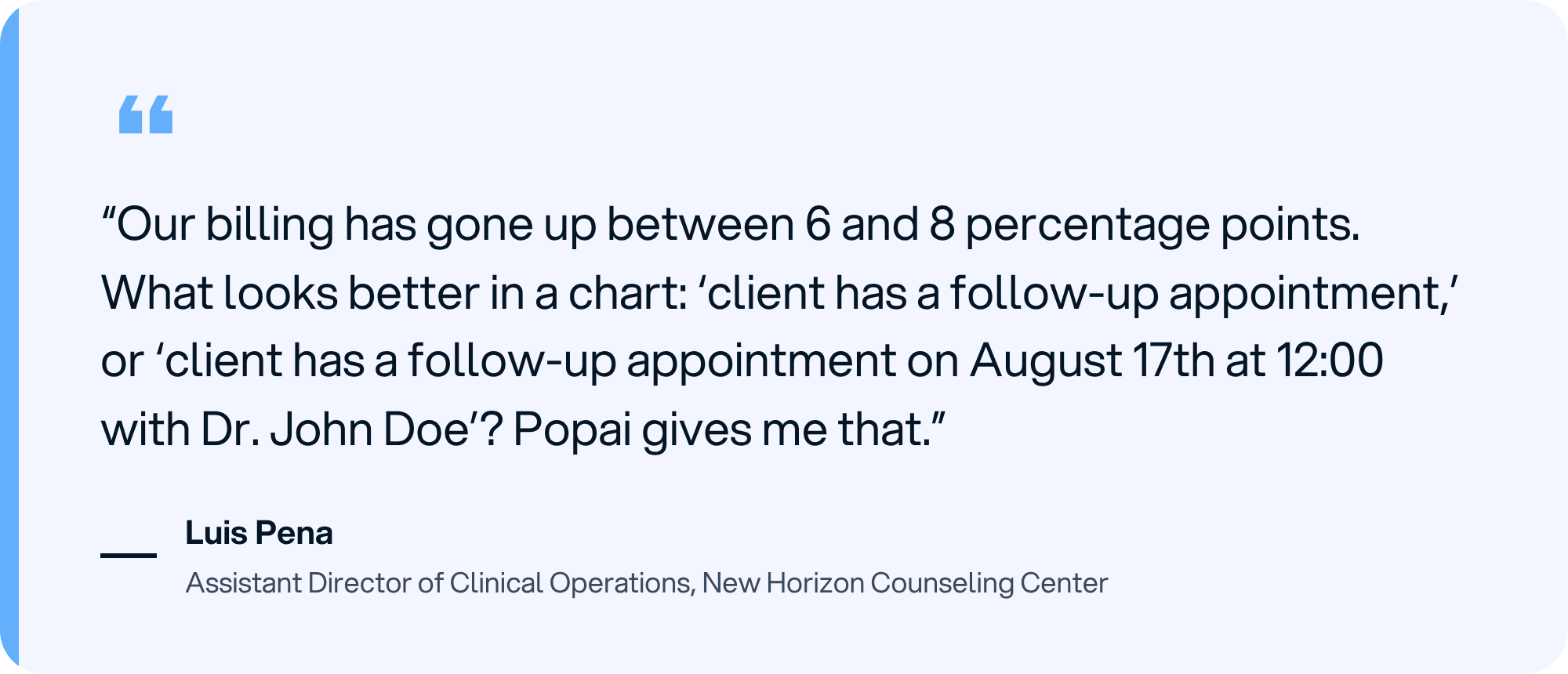
NHCC partnered with Popai to reduce the administrative burden, increase care team capacity, and improve program performance by capturing and analyzing the patient conversations at the center of this program. In the months after rollout, care managers reduced documentation time per encounter by 67% to 89%, billable services across the Health Home program increased by 6–8 percentage points, and supervisors could see, for the first time, where each care manager needed support and how to best prioritize time and resources.

The Challenge
The Health Home program is delivered primarily through home visits and phone conversations, where members share critical clinical and social information and care managers coordinate the appropriate response. Timely, accurate documentation is essential: encounter notes must be completed within three to five business days, and reimbursement and audit compliance depend on a clear record of the services provided.
At NHCC, (prior to working with Popai) care managers documented encounters after the fact, relying on memory and handwritten notes. Many spent one to two hours at the end of each day reconstructing their conversations. Important details were sometimes captured only partially, while some encounters went undocumented altogether. The care had been delivered, but the record did not always reflect the full scope of the work.
Supervisors faced the same visibility gap. With more than 100 care managers across four counties, quality assurance depended largely on chart spot-checks and calls to members to confirm contact. Leadership could see only what had been entered in the chart—not the full picture of what was happening in the field or over the phone.
The Work
A pilot across three segments
NHCC started with a pilot across six care coordinators — two of the team’s strongest performers, two who were struggling, and two new hires. They used Popai for 2 to 3 months while leadership tracked how care managers responded, the quality of the notes, and what happened to their capacity.
The strong performers kept performing at their level. One of the two struggling care coordinators came off of a performance improvement plan, and the new hires produced notes at the required quality from their first weeks on the job. After onboarding additional care managers to the pilot, leadership presented the results to the organization’s senior team and approved the expansion of Popai to the full team. Today, more than 100 care managers, supervisors, and program leaders across the Health Home program work with Popai.

How Popai works at NHCC
Each care manager works from a Popai phone number. Popai captures every call placed or received through it and delivers a compliant, Health Home-formatted note securely within seconds; the care manager reviews, edits, and files it to the system of record (Foothold Care Management). Popai supports multi-participant calls and over 70 languages — delivering the note in English — and summarizes missed calls and voicemails.
Popai gives supervisors a view of call volume and quality, including but not limited to core services detected on each call, conversation topics by domain, performance measures for each care manager, and a patient frustration tracker that flags severe cases for follow-up. NHCC compares detected services against its billing records each month.
The Results
Complete documentation, higher billing
Encounter notes now carry specific, measurable detail: medication names and dosages, provider details, phone numbers, dates, etc. Each note builds on the previous conversation so charts show the “golden thread” that Health Home audits look for. Notes reach the EHR sooner: care managers now file encounters within minutes of the call.
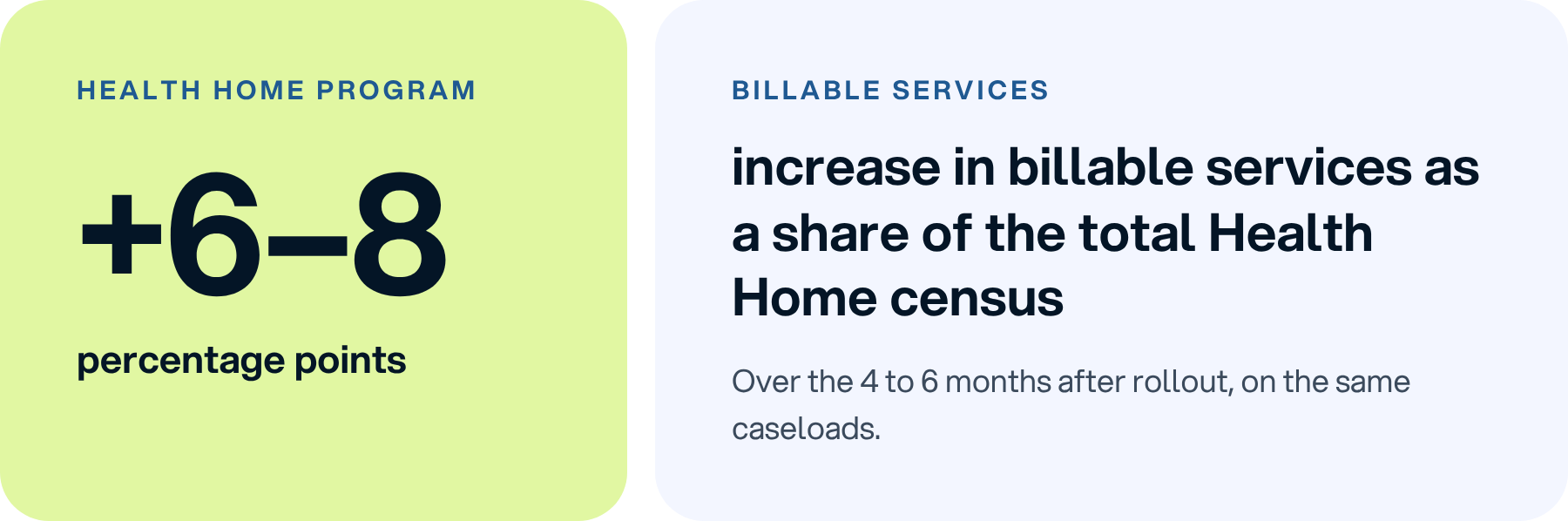
The financial result follows directly. Over the 4 to 6 months after rollout, NHCC increased its billable services by 6 to 8 percentage points as a share of its total Health Home census — on the same caseloads.
More capacity on the same caseloads
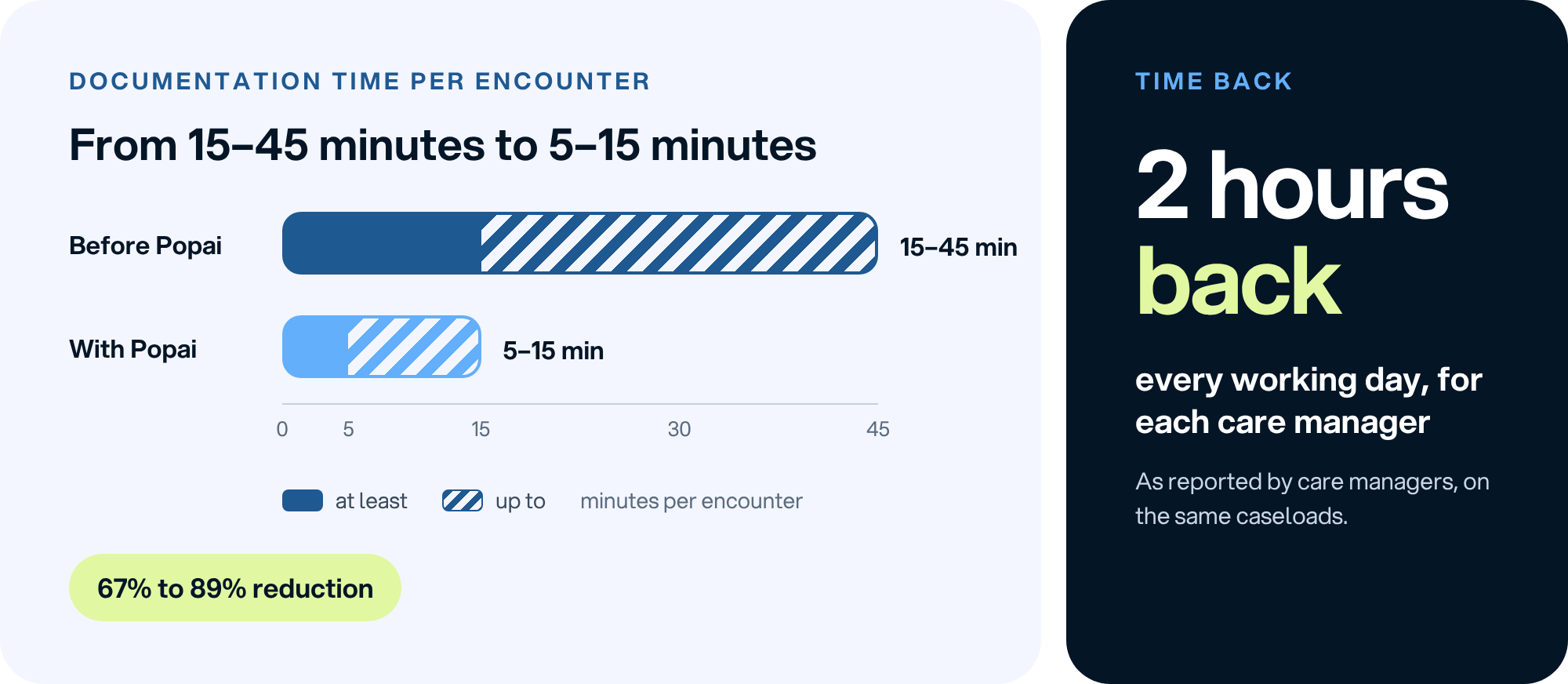
Care managers report getting 2 hours back per working day: documentation time per encounter dropped from 15–45 minutes to 5–15, at a reduction of 67% to 89%. They also report being more present on calls, focused on the patient rather than on capturing every detail.
NHCC has kept the same caseloads, and puts the recovered time back into the program: comprehensive assessments have increased since the Popai rollout, newly enrolled members are reached sooner, and senior care coordinators who finish their caseloads cover an additional 5 to 10 members each month and train new hires.

Visibility that directs coaching
Supervisors now see their teams’ work at the level of the call: call volume, core services, member frustration, and how each care manager scores on empathy and patient experience. These views direct training: when conversation-domain data showed call time concentrated on medical topics, leadership redirected it toward mental health check-ins; where a care manager’s call activity was high but documented core services were low, supervisors coached toward those services with call-based evidence.

What’s Next
NHCC and Popai are now applying the conversation data to the program's core performance measures. Two initiatives are underway:
- Closing gaps in care. Popai cross-references NHCC’s open gap measures against what members have said in past conversations, surfacing gaps that were already addressed but never recorded, increasing the rate of closed gaps and focusing the team on the ones that remain open.
- In-person encounter documentation. Much of Health Home work happens face to face. Popai is extending the same automated documentation to in-person visits.

The Conclusion
NHCC's partnership with Popai shows what changes when patient conversations are captured and analyzed at scale. Care managers are freed up to focus on their patients, billing increases as documentation matches the care delivered, and supervisors support and coach their teams based on a comprehensive view of their effort and output, rather than the fragments of work that made it into the chart. The next phase uses the data surfaced in patient conversations to raise the program’s performance: closing gaps in care, responding to patients’ needs as they surface, and reaching members between visits.
Frequently Asked Questions


Yes. Popai can integrate with your EMR, EHR, or CRM systems through APIs or custom workflows. It also integrates with your telephony system.
Yes. Popai uses advanced voice separation and diarization technology to distinguish between speakers and accurately attribute who said what.
Popai uses state-of-the-art voice recognition and natural language processing models to ensure highly accurate transcription and data extraction, even in noisy environments.
Yes. Popai is HIPAA and Soc 2 Compliant. Popai is built from the ground up with privacy and security in mind.
Popai supports over 70 languages, including Spanish, Mandarin, Cantonese, Japanese, Bengali, Wolof, Fulani, and Haitian Creole. All automated notes are drafted in English.
Still have questions?
Book a quick demo and get the answers you need - no strings attached.